

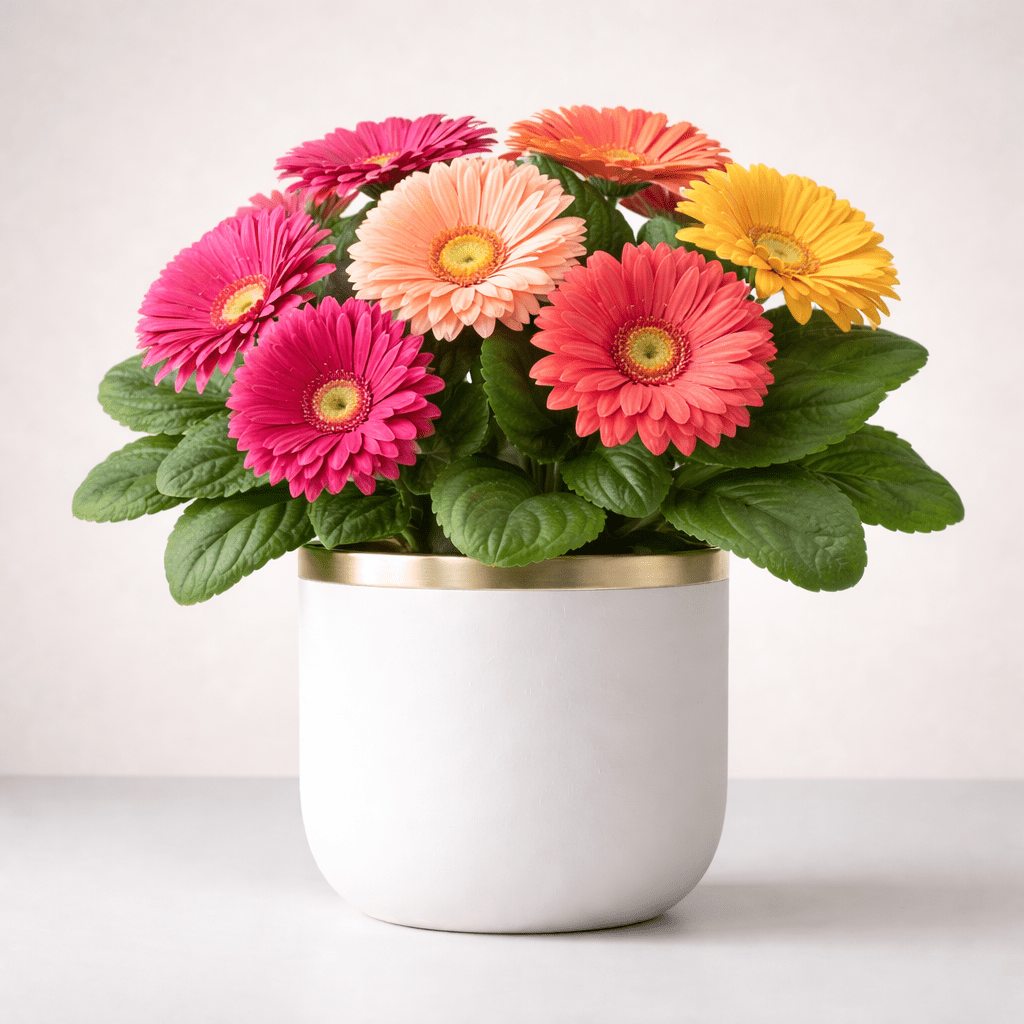
Gerbera Daisy Plant
₹199
View & Listen Plant Education

Gerbera Daisy Plant - Video Guide
Watch Video
All Details
A vibrant and cheerful flowering plant, celebrated for its large, brilliantly colored, daisy-like blooms that sit atop tall, leafless stems. A symbol of happiness and innocence, it brings a powerful splash of color to gardens, containers, and bouquets alike.
I am a herbaceous perennial, often grown as an annual in cooler climates, forming a low clump of attractive, lobed, dark green leaves.
My most distinctive feature is my large, solitary, composite flower heads that come in a stunning spectrum of colors—red, orange, yellow, pink, white, and salmon. The flowers have a prominent central disc surrounded by radiating ray petals.
My blooms are held well above the foliage on strong, fuzzy stems, making them excellent as long-lasting cut flowers.
I am a member of the vast Asteraceae family, and what appears as a single flower is actually a cluster of hundreds of tiny individual flowers (the central disc) surrounded by showy petal-like ray florets.
I am native to South Africa, specifically the regions of the Eastern Cape, Mpumalanga, and KwaZulu-Natal, as well as parts of Asia and South America.
I require consistent, moderate moisture. I dislike being bone dry or waterlogged.
Water deeply at the base of the plant when the top inch of soil feels dry. Avoid wetting the crown (center) of the plant or the foliage, as this promotes fungal diseases.
Ensure excellent drainage. Overwatering leads to crown and root rot.
I am somewhat drought-tolerant once established but will not bloom well under water stress.
I am a full sun to partial sun lover. For the best and most abundant blooms, I need at least 4-6 hours of direct sunlight daily.
In very hot climates, I appreciate light afternoon shade to prevent scorching and help blooms last longer.
Too little sun results in leggy growth, weak stems, and few to no flowers.
I thrive in moderate temperatures and am best suited to USDA zones 8-10 as a perennial.
My ideal growing range is 18°C to 24°C. I can tolerate warmer temperatures with adequate water.
I am not frost-hardy. Frost will kill the foliage and flowers. In cooler zones, I am grown as a summer annual or brought indoors.
I am a versatile bedding plant, container star, and cut flower garden essential. Plant me in masses for a dramatic effect.
Plant in rich, well-draining, slightly acidic to neutral soil. Amend garden beds with compost.
Ensure the crown of the plant (where the stem meets the roots) is slightly above soil level to prevent rot.
Space plants 30-45 cm apart to allow for good air circulation.
Deadhead spent flowers regularly to encourage continuous blooming.
I am a moderate to heavy feeder to support my prolific blooming.
Fertilize every 2-3 weeks during the growing season (spring to fall) with a balanced, water-soluble fertilizer or one formulated for flowering plants.
A fertilizer higher in phosphorus (the middle number) can promote bigger, more numerous blooms.
Scientific Name: Gerbera jamesonii (and numerous hybrids)
Common Names: Gerbera, Transvaal Daisy, African Daisy
Plant Family: Asteraceae (Daisy family)
Plant Type: Tender perennial, often grown as an annual
I am generally considered non-toxic to cats, dogs, and horses by the ASPCA. I am a safe choice for gardens and homes with curious pets, though ingestion of large amounts may cause mild gastrointestinal upset simply due to fiber content.
While not as famous as some foliage plants, I am recognized for my ability to remove common indoor air pollutants like benzene, formaldehyde, and trichloroethylene from the air, particularly when grown indoors.
Hey there!

Madhuram Applewood CityMall