

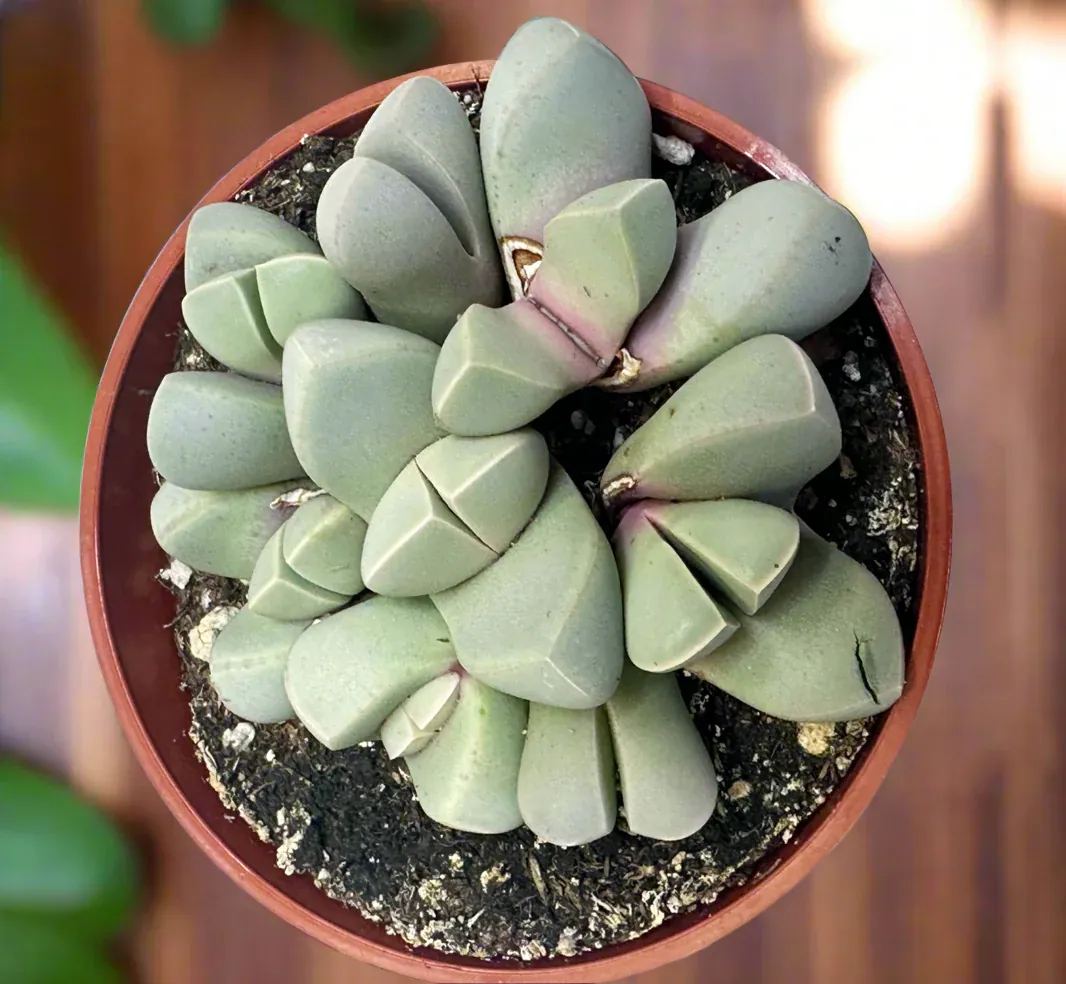
Karoo Rose Plant
₹299
View & Listen Plant Education

Karoo Rose Plant - Video Guide
Watch Video
All Details
A remarkable and cryptic succulent that mimics the appearance of a split stone or a cluster of pebbles. Its unique, rock-like form and stunning, daisy-like flowers make it a prized gem for collectors of rare and unusual succulents.
I am a small, stemless, clump-forming succulent that grows almost completely buried in the ground, with only the tops of my leaves visible.My most distinctive feature is my pair of extremely thick, fleshy, gray-green to brownish leaves that are fused at the base, forming a cleft or pebble-like body often with a "split" down the center. My surface can be smooth, textured, or dotted.I am a master of camouflage (a form of lithops mimicry), blending seamlessly into my rocky native habitat to avoid herbivores.In late summer or fall, I produce a spectacular, solitary, shimmery flower (white, pink, yellow, or purple) with a central cone of stamens, which emerges dramatically from the cleft between my leaves. The flower often dwarfs the plant itself.
I am native to the sun-baked, arid deserts and scrublands of the Karoo region in South Africa and Namibia.
I have a very strict seasonal watering schedule tied to my growth cycle. Overwatering is the fastest way to kill me.Water ONLY during my active growth periods (typically late summer to autumn, when I flower or produce new leaves). Use the "soak and dry" method, then let the soil dry completely.Keep COMPLETELY DRY during my dormancy (typically late spring and summer, and again in the dead of winter). During this time, my old leaves will shrivel as new ones develop inside.Never water when I am splitting or showing no signs of growth.
I require very bright, direct light to maintain my compact form and to flower. A south-facing windowsill or grow light is essential indoors.I can tolerate some intense sun, but in extremely hot climates, very light afternoon shade may prevent scorching.Insufficient light causes elongated, weak, pale growth that ruins my stone-like appearance.
I thrive in conditions that mimic my desert home: warm days and cool nights.My ideal active growth range is between 15°C to 27°C.I need a dry, cool dormancy and can tolerate light frost only if the soil is bone dry, but protection from freezing temperatures (below -2°C) is safest.
I am a specialist collector's plant, perfect for shallow pots (pans) in succulent dish gardens or alone as a living stone specimen.Drainage is critical. Plant me in a very gritty, mineral-based mix (e.g., 80% pumice, perlite, or coarse sand to 20% potting soil).My "body" should sit slightly above the soil line, and the pot should be topped with a layer of fine gravel or sand to mimic my natural setting and improve drainage.Handle with care; I am small and my roots are delicate.
I am an incredibly light feeder. Fertilizer is rarely needed.If desired, a single, highly diluted dose of low-nitrogen, cactus fertilizer at the very beginning of the active growth period can be given.Never fertilize during dormancy.
Scientific Name: Lapidaria margaretaeCommon Names: Karoo Rose, Stone PlantPlant Family: Aizoaceae (Ice Plant family)Plant Type: Dwarf perennial succulent, "mesemb" or mimicry plant
I am not known to contain substances toxic to cats, dogs, or humans. However, as with any non-food plant, ingestion of large quantities may cause mild gastrointestinal discomfort. The primary risk is physical—I am a small choking hazard.
My size is too small to have any measurable impact on indoor air quality. My value is purely ornamental and botanical.
Hey there!

Madhuram Applewood CityMall