
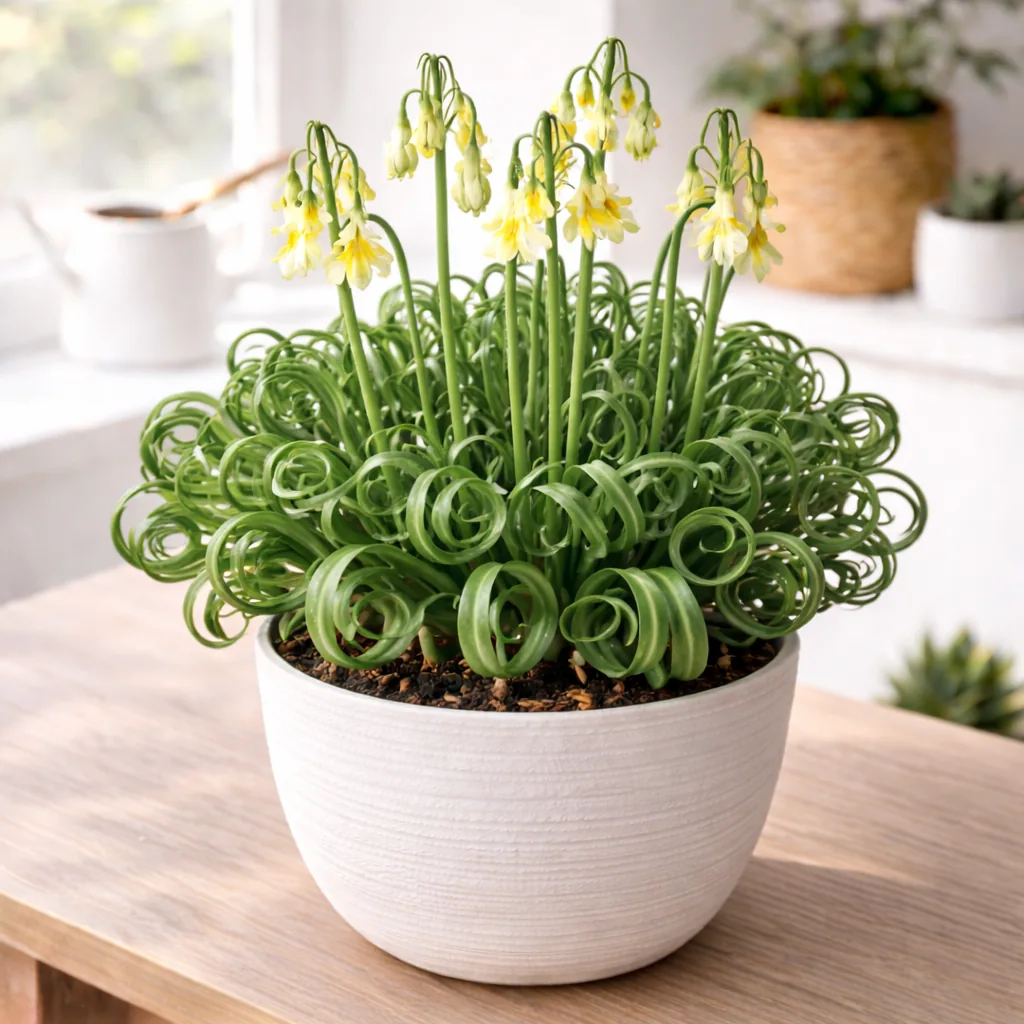
Albuca Plant
₹199
View & Listen Plant Education

Albuca Plant - Video Guide
Watch Video
All Details
A whimsical and captivating genus of bulbous plants, famed for their often curly, spiraling leaves and unusual, fragrant flowers that seem to defy gravity. A conversation-starting oddity for succulent and bulb collectors.
I am a bulb-forming perennial with a distinct seasonal growth cycle. My most active growth occurs in the cooler months.
My most distinctive feature is my foliage. In many species (like Albuca spiralis), the leaves are tightly coiled or corkscrewed like green springs. In others, they are tall, slender, and arching. This coiling is a response to bright light.
My flowers are equally peculiar. I produce tall, slender flower stalks topped with racemes of nodding, bell-shaped flowers that are typically greenish-yellow or white with a distinctive green stripe on each petal. The flowers often have a sweet, buttery, or vanilla-like fragrance.
I have a sticky sap that can be a mild skin irritant for some people.
I am native to Southern Africa (primarily South Africa and Namibia), where I grow in arid, rocky, or grassy habitats.
My watering needs are strictly seasonal. I follow a "grow in winter, rest in summer" cycle in the Northern Hemisphere.
Water regularly and deeply during my active growth period (fall through spring), allowing the soil to dry out partially between waterings. This is when leaves and flowers appear.
As temperatures rise in late spring/summer, my leaves will begin to yellow and die back. This is my signal for dormancy. Gradually reduce watering, then stop completely for 2-3 months. Keep the bulb dry and warm.
Overwatering during dormancy will rot the bulb.
I require very bright, direct light to thrive and, for spiral-leaved species, to induce the characteristic coiling.
A south-facing window is ideal. Insufficient light results in weak, straight, floppy leaves that lose their quirky form and a failure to flower.
I can tolerate some full sun, but in the hottest climates, light afternoon shade may prevent leaf scorch.
I prefer moderate temperatures during my growth season, with cool nights.
My ideal growing range is 10°C to 25°C.
For spiral-leaved species, a distinct difference between day and night temperatures encourages tighter curling.
During summer dormancy, I need a warm, dry rest period.
I am an excellent potted plant for windowsills, rock gardens, or alpine houses. My bulb should be planted with its neck and shoulders above the soil surface.
Use an extremely well-draining, gritty mix (e.g., cactus/succulent mix with added perlite or pumice).
Choose a pot with excellent drainage holes. A shallower, wider pot (bulb pan) is often better than a deep one.
Plant bulbs in early fall, just as the growth cycle begins.
I am a light feeder. Fertilize only during active growth.
Apply a balanced, water-soluble fertilizer diluted to half-strength once a month from fall until flowering finishes.
Do not fertilize during dormancy.
Scientific Name: Albuca spp. (e.g., A. spiralis, A. concordiana, A. bracteata, A. nelsonii)
Common Names: Slime Lily, Spiral Grass, Frizzle Sizzle, Corkscrew Albuca
Plant Family: Asparagaceae (subfamily Scilloideae)
Plant Type: Deciduous, perennial geophyte (bulb)
I contain compounds that are toxic to cats and dogs if ingested. The specific toxins can cause vomiting, diarrhea, and drooling. While not considered severely lethal, it's best to keep me out of reach of curious pets. The sap may also cause mild skin irritation.
My small size and seasonal nature mean I have no significant air-purifying capabilities. My value is purely aesthetic and botanical.
Everyday: from 9:00AM to 7:00PM