
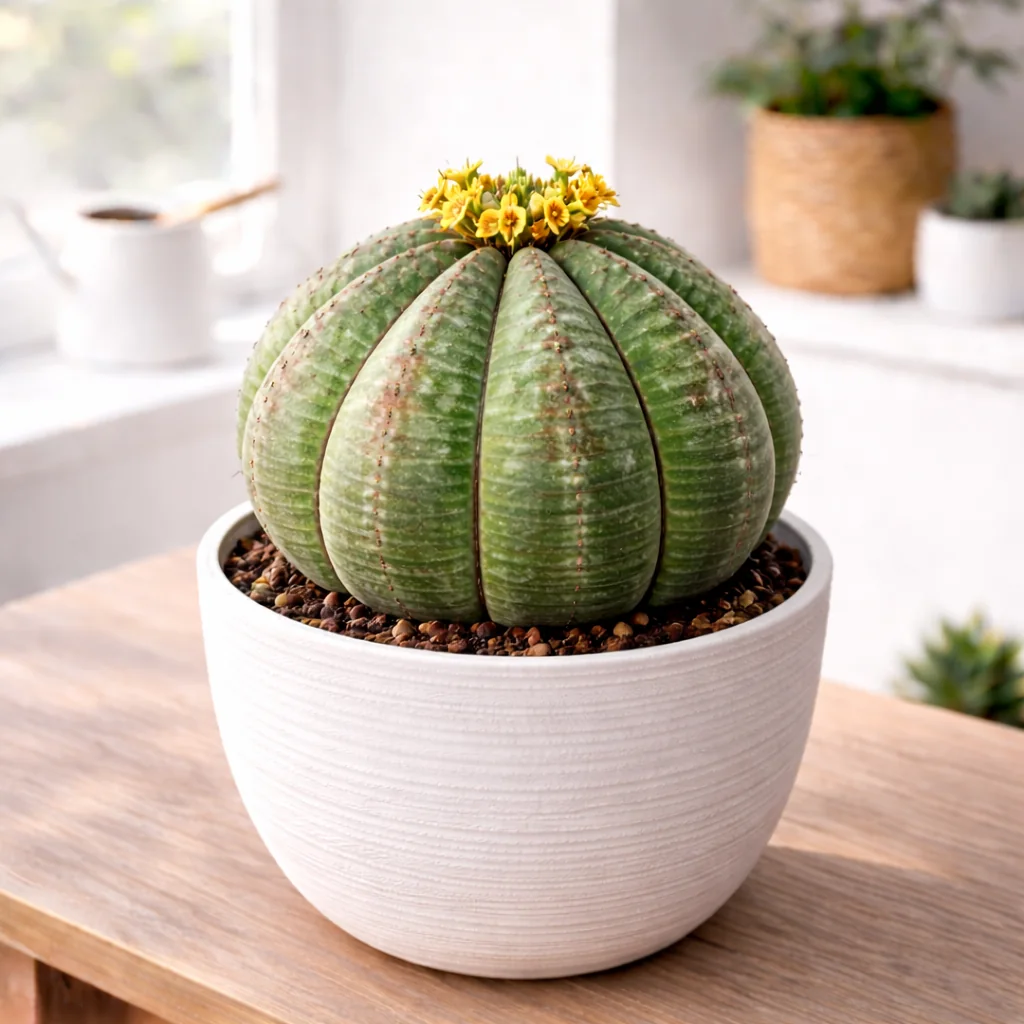
Baseball Plant
₹199
View & Listen Plant Education
Baseball Plant - Video Guide
Watch Video
All Details
A highly unique and rare succulent, famous for its near-perfect spherical, segmented shape that resembles a baseball or a sea urchin. It is a slow-growing, leafless plant prized by collectors for its geometric form and specialized adaptations to arid environments.
I am a small, globe-shaped succulent composed of 8 vertical, slightly raised ribs that divide my surface into distinct, rounded sections.
My most iconic feature is my perfectly round, ball-like shape when young, which may become more cylindrical with age. My skin is green, often with a subtle blue-gray hue and brownish markings along the seams.
I am dioccious, meaning individual plants are either male or female. Males produce small, yellow, cup-like flowers on long stalks; females produce three-lobed seed pods.
I belong to the Euphorbia family and, like many euphorbias, I produce a toxic, milky latex sap when injured.
I am native to the arid, rocky regions of the Great Karoo in South Africa.
I am an extremely drought-tolerant succulent. My water needs are minimal.
Use the "soak and dry" method very infrequently. Water only when the soil is completely dry and the plant shows slight signs of softness or shrinkage. This may be every 3-4 weeks in hot summer and once a month or less in winter.
I am highly prone to rot from overwatering. Excellent drainage and a long dry period between waterings are critical.
Avoid getting water on the crown of the plant, as it can pool in the seams and cause rot.
I require plenty of bright, direct sunlight to maintain my compact, spherical shape.
Provide at least 4-6 hours of direct sun daily. A south-facing window or a spot under strong grow lights is essential indoors.
Too little light will cause etiolation—the plant will stretch and become elongated, losing its prized baseball shape.
I can tolerate intense sun but may need slight protection from the hottest afternoon sun in extreme climates to prevent scorching.
I prefer warm, dry conditions and am best suited to USDA zones 10-11 if grown outdoors.
My ideal range is 18°C to 27°C during the growing season.
I require a cooler, dry winter rest period with temperatures around 10°C-15°C to encourage health and potential flowering. I am not frost-tolerant.
I am a collector's specimen plant, best showcased in a small, individual pot.
Plant me in an extremely well-draining, mineral-based mix. Use a cactus/succulent soil amended with extra pumice, perlite, or coarse sand (at least 70% grit).
Use a shallow, wide pot with excellent drainage holes. My root system is relatively small.
Handle with extreme care to avoid damaging the skin and to prevent contact with the toxic sap. Use gloves and tools.
I am a very light feeder. Fertilize only during the active growing season (spring and summer).
Use a balanced, water-soluble fertilizer diluted to 1/4 strength, or a cactus/succulent fertilizer, once at the beginning of the season.
Over-fertilizing can cause weak, distorted growth.
Scientific Name: Euphorbia obesa
Common Names: Baseball Plant, Sea Urchin Euphorbia, Gingham Golf Ball
Plant Family: Euphorbiaceae
Plant Type: Perennial succulent, dioccious
Like all euphorbias, I contain a milky white latex sap that is toxic and a severe irritant. If ingested by pets or humans, it causes mouth irritation, vomiting, and diarrhea. Contact with skin or eyes can cause dermatitis, redness, swelling, and temporary blindness. Handle with gloves and keep far out of reach of pets and children.
Negligible. I am a small, slow-growing plant grown exclusively for its unique ornamental form.
Everyday: from 9:00AM to 7:00PM